

Watch this scientifically-accurate video depicting the development of a person from conception until birth.
Watch this scientifically-accurate video depicting the development of a person from conception until birth.
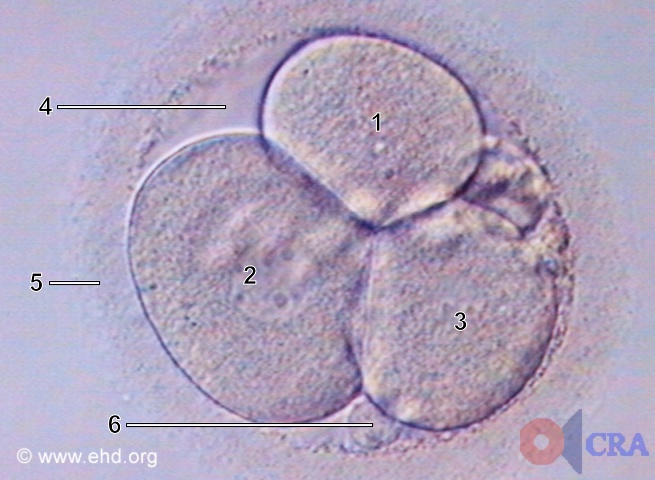
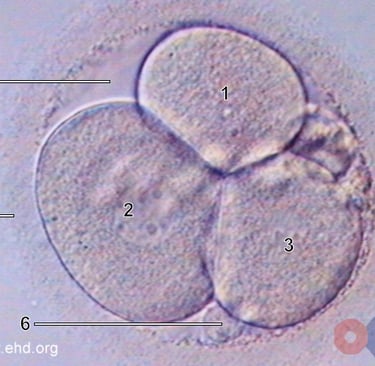
"The very young human being, just after fertilization, after it has split in two cells and then in three cells because curiously we do not split ourselves in two, four, eight and continue like that, no, at the beginning we don’t do that. We split in two cells of roughly equal dimension and one of the two cells splits in two. There is a moment in which inside the zona pellucida which is a kind of plastic bag, which is, so to speak, the wall of the private life of the embryo in which it is protected from the outside, we have a stage in which there are three cells. This has been known for fifty, sixty years, and it was remaining a mystery for embryology, because after that stage of three cells, it starts again, it comes to four, and it continue by multiples of two.
It’s probably at that time that a message goes from one cell to the two other cells, come back to the first one and suddenly realize we are not a population of cells. We are bound to be an individual. That is individualization, that makes the difference between a population of cells which is just a tissue culture and an individual which will build himself according to his own rule, is demonstrated at the three cell stage, that is very soon after fertilization has occurred."
-Jerome Lejeune, Symphony of the Preborn Child
"The very young human being, just after fertilization, after it has split in two cells and then in three cells because curiously we do not split ourselves in two, four, eight and continue like that, no, at the beginning we don’t do that. We split in two cells of roughly equal dimension and one of the two cells splits in two. There is a moment in which inside the zona pellucida which is a kind of plastic bag, which is, so to speak, the wall of the private life of the embryo in which it is protected from the outside, we have a stage in which there are three cells. This has been known for fifty, sixty years, and it was remaining a mystery for embryology, because after that stage of three cells, it starts again, it comes to four, and it continue by multiples of two.
It’s probably at that time that a message goes from one cell to the two other cells, come back to the first one and suddenly realize we are not a population of cells. We are bound to be an individual. That is individualization, that makes the difference between a population of cells which is just a tissue culture and an individual which will build himself according to his own rule, is demonstrated at the three cell stage, that is very soon after fertilization has occurred."
-Jerome Lejeune, Symphony of the Preborn Child
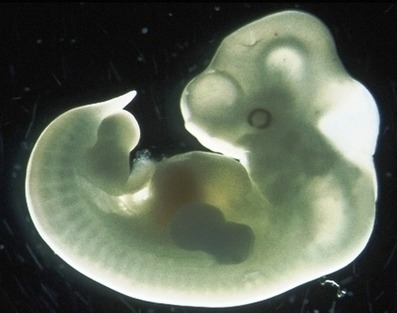
5 week embryo graphdiagraph.com
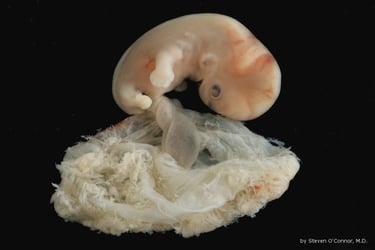
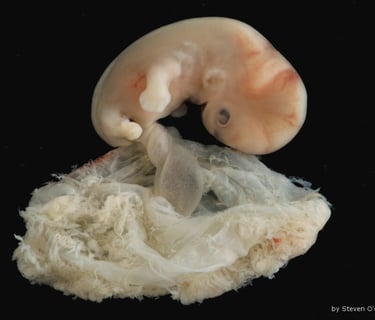
6 week embryo Steve O'Connor, MD humpath.com
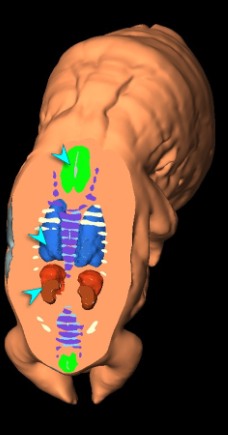
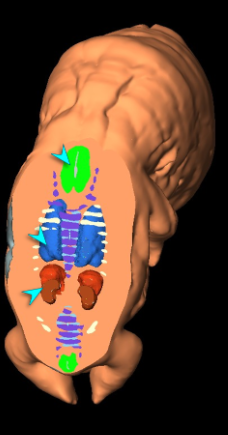
8 week 3D model 3Dhumandevelopment.com
12 week fetus
New York: Dr. Landrum B. Shettles held a human being in the palm of his left hand, 1971

Development of the Individual
Pregnancy weeks are counted from the first day of the last menstrual period before pregnancy. The age of the unborn individual given in pregnancy weeks is about two weeks higher than the actual age calculated from fertilization.
Fertilization
During fertilization, a sperm cell unites with an egg cell, and the chromosomes from both gametes merge. This forms a new human individual. The new individual is called a zygote. From the very beginning, it is a living individual of the human species with a unique genetic code. All the new individual’s genetic traits—such as those affecting eye color, the shape of the little finger, sex, intelligence, and innate temperament—are determined at fertilization.Cell division begins soon after fertilization. After the first five days, the embryo consists of over a hundred cells, and cell differentiation has begun. Implantation, or the embryo’s attachment to the uterine lining, occurs about 6–10 days after fertilization.

4–6 Pregnancy Weeks (2–4 Weeks from Fertilization)
Only 3 weeks and 1 day after fertilization - the heart begins to beat. Eyes, ears, and face begin to develop at the same time. By the end of the fourth week, the developing upper and lower limbs are visible, and the forebrain, midbrain, and hindbrain have formed.
6–8 Pregnancy Weeks (4–6 Weeks from Fertilization)
Eyes, nose, and mouth are distinguishable. By the sixth week, the unborn individual can move spontaneously and respond to touch on sensitive skin areas and the eyelids begin to develop.
10 Pregnancy Weeks (8 Weeks from Fertilization)
Almost all organs are in place in recognizable form. Fingers and toes have formed, and the face clearly looks human. Can make breathing movements, turn its head, stretch, and touch its face with its hand. Early signs of right- or left-handedness can be observed by monitoring movements.
Though gender is determined at fertilization, genitalia now distinguish male from female.

12 Pregnancy Weeks (10 Weeks from Fertilization)
Fingernails appear. Fetal pain experience may be possible from about 12–13 weeks of pregnancy.
Between 11 and 12 weeks, a second huge burst of growth occurs as weight increases by roughly 58 percent.

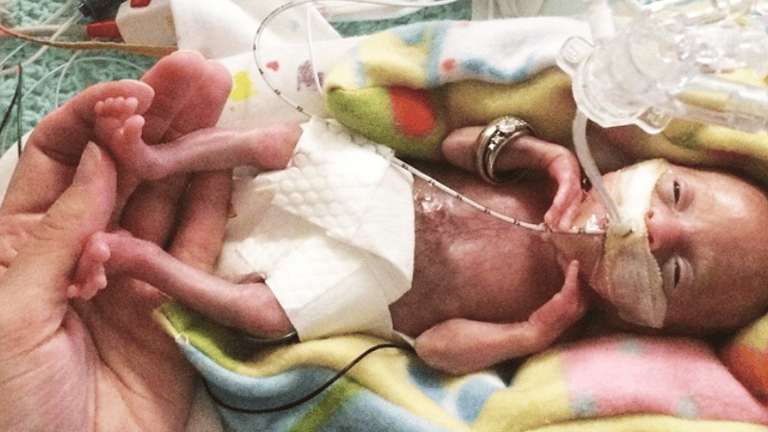
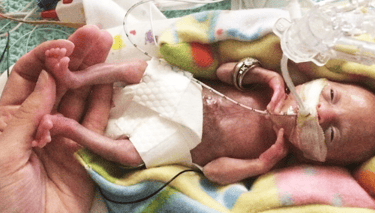
In July 2025, Nash Keen, a cheerful, determined, and curious one-year-old who survived birth at exactly 21 weeks, made headlines—one day younger than the previous world record for the youngest surviving premature baby. Nash received care at the University of Iowa Hospital, which specializes in the care of the smallest preemies; at least seven out of twenty children born before 22 weeks there have survived.
5 week embryo graphdiagraph.com
6 week embryo Steve O'Connor, MD humpath.com
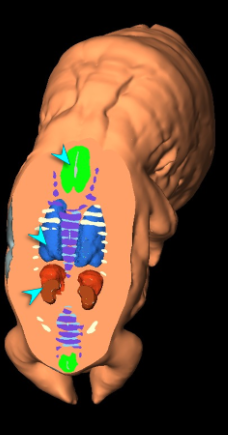
8 week 3D model 3Dhumandevelopment.com
12 week fetus
New York: Dr. Landrum B. Shettles held a human being in the palm of his left hand, 1971
Development of the Individual
Pregnancy weeks are counted from the first day of the last menstrual period before pregnancy. The age of the unborn individual given in pregnancy weeks is about two weeks higher than the actual age calculated from fertilization.
Fertilization
During fertilization, a sperm cell unites with an egg cell, and the chromosomes from both gametes merge. This forms a new human individual. The new individual is called a zygote. From the very beginning, it is a living individual of the human species with a unique genetic code. All the new individual’s genetic traits—such as those affecting eye color, the shape of the little finger, sex, intelligence, and innate temperament—are determined at fertilization.Cell division begins soon after fertilization. After the first five days, the embryo consists of over a hundred cells, and cell differentiation has begun. Implantation, or the embryo’s attachment to the uterine lining, occurs about 6–10 days after fertilization.
4–6 Pregnancy Weeks (2–4 Weeks from Fertilization)
Only 3 weeks and 1 day after fertilization - the heart begins to beat. Eyes, ears, and face begin to develop at the same time. By the end of the fourth week, the developing upper and lower limbs are visible, and the forebrain, midbrain, and hindbrain have formed.
6–8 Pregnancy Weeks (4–6 Weeks from Fertilization)
Eyes, nose, and mouth are distinguishable. By the sixth week, the unborn individual can move spontaneously and respond to touch on sensitive skin areas and the eyelids begin to develop.
10 Pregnancy Weeks (8 Weeks from Fertilization)
Almost all organs are in place in recognizable form. Fingers and toes have formed, and the face clearly looks human. Can make breathing movements, turn its head, stretch, and touch its face with its hand. Early signs of right- or left-handedness can be observed by monitoring movements.
Though gender is determined at fertilization, genitalia now distinguish male from female.
12 Pregnancy Weeks (10 Weeks from Fertilization)
Fingernails appear. Fetal pain experience may be possible from about 12–13 weeks of pregnancy.
Between 11 and 12 weeks, a second huge burst of growth occurs as weight increases by roughly 58 percent.
In July 2025, Nash Keen, a cheerful, determined, and curious one-year-old who survived birth at exactly 21 weeks, made headlines—one day younger than the previous world record for the youngest surviving premature baby. Nash received care at the University of Iowa Hospital, which specializes in the care of the smallest preemies; at least seven out of twenty children born before 22 weeks there have survived.
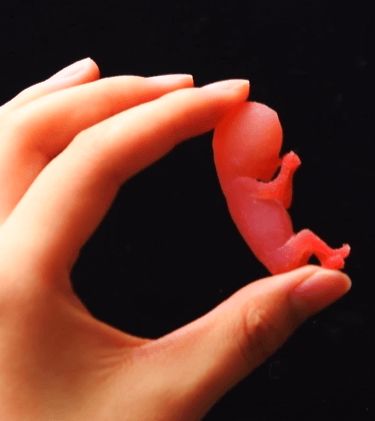
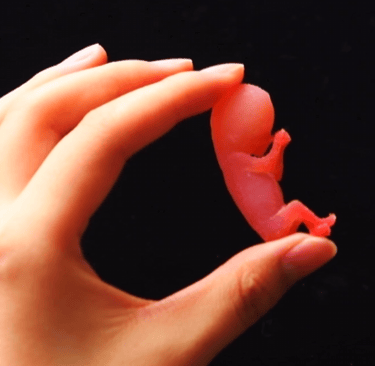
10 week model 3Dhumandevelopment.com
Text by: Dr. Marika Kaksonen
Copyright © Artikla 3 ry 2025, artikla3.fi